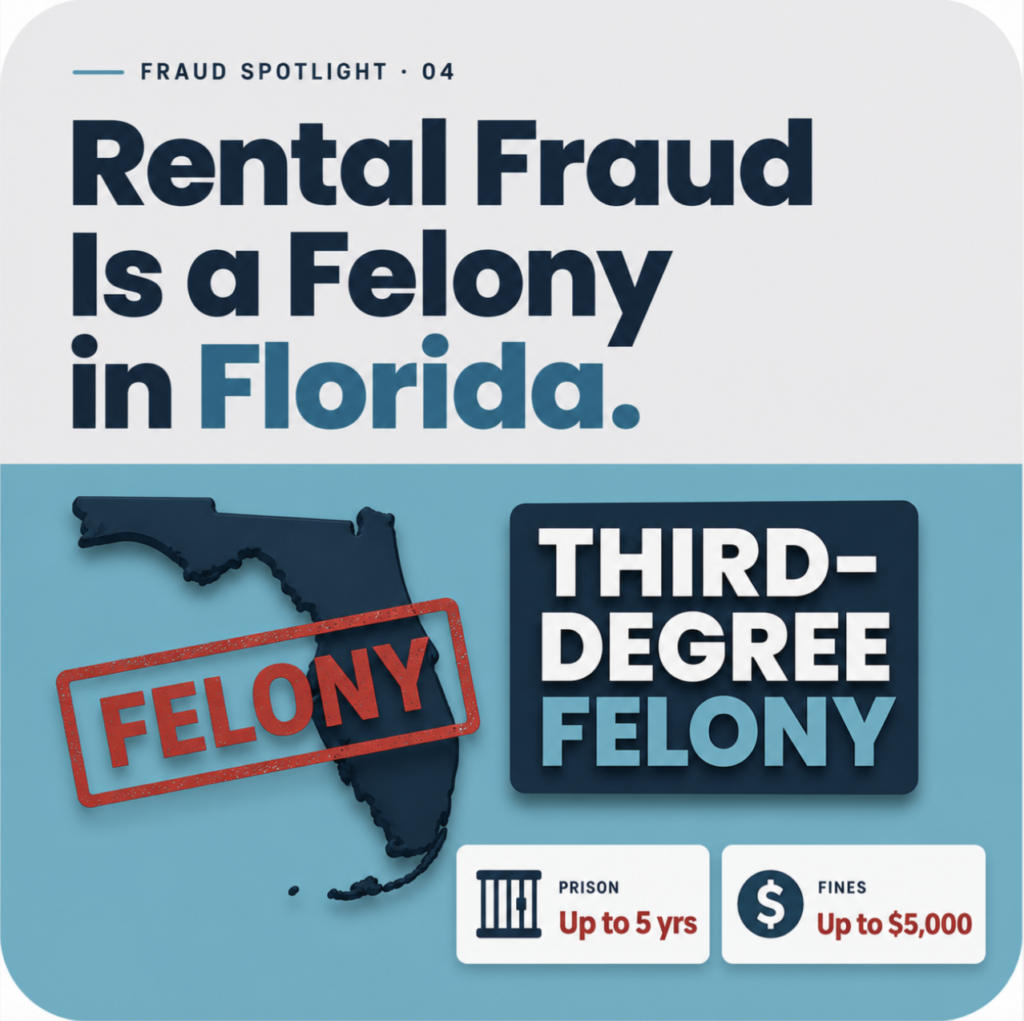
On October 1, 2026, lying your way into a lease becomes a third-degree felony in Florida. Here is what the new Florida rental fraud law does, where it stops, and why detection is the part operators cannot skip.
What the Florida Rental Fraud Law Does
Florida passed one of the strongest rental-fraud laws in the country. CS/HB 1293 creates a new crime: “Fraudulent Entry of a Residential Dwelling Unit.” Take possession of a rental using false identity, fake documents, or impersonation, and it is now a third-degree felony. Up to five years in prison and a $5,000 fine.
In fact, the vote was unanimous. Senate 34-0. House 110-0. The Florida Apartment Association and National Apartment Association backed it. It takes effect October 1, 2026.
Key Facts: CS/HB 1293
- New crime: Fraudulent entry of a residential dwelling unit
- Classification: Third-degree felony
- Penalty: Up to 5 years in prison and a $5,000 fine
- Covered: Fake pay stubs, forged IDs, stolen or synthetic identities, false income claims, impersonation
- Eviction: Non-curable violation. 7-day notice to vacate. No chance to cure.
- Effective: October 1, 2026
Why It Matters
Rental fraud used to sit in a gray zone. A forged pay stub cost operators thousands in lost rent and legal fees, but rarely led to charges. As a result, operators treated fraud as a cost of doing business.
That changes now, because fraud is a felony. And because it is non-curable, landlords can move to evict on the fraud alone. Moreover, Florida will not be the last state to act. Screening rigor is becoming table stakes.
Where the Law Stops
A felony statute is a consequence. It is not a detector.
The law punishes fraud after it happens. It does not tell you the pay stub was faked, the bank statement was altered, or the SSN was stolen. It assumes you already caught it. However, most screening does not.
That is the gap:
- You have to catch the fraud first. If a forged document clears your screen, no crime is ever recorded. No case. No deterrent.
- By the time you find out, you have lost. A skip. A missed payment. An eviction. The unit is empty, the rent is gone, and the felony statute is cold comfort.
- Charges require proof. Felony cases hinge on documented, forensic evidence of fraud. A suspicion is not a case.
The law gives you a stick. Detection is what lets you use it, or better, never need it.
Why Standard Screening Fails
Fraudulent documents hit leasing queues every day. Yet standard screening cannot tell the difference.
- Visual review misses document fraud. A statement showing $23,000 over a $10 balance does not flag itself. Forgeries are built to pass a glance.
- Credit checks confirm a number, not a person. A credit pull does not prove the applicant is who they claim or that the SSN might have been fabricated. That is exactly what stolen and synthetic identities exploit.
- Applicant documents are taken as truth. When screening starts from what the applicant submits, every clean-looking forgery gets approved.
- Incomplete, white-labeled fraud detection misses as much as it catches. Most services that claim to detect fraud rely on a third-party, and the resellers they use only catch the simpler forms of fraud. Domain expertise with self-built authentication and reading technology is what delivers truly accurate and verified results.
How Docuverus Closes the Gap
Docuverus was built for this. We founded the company in 2018 and built the first document authentication model and the first earnings-statement reading platform in the industry. Since then, we have spent years solving this problem.
Our engine runs Multidimensional Metadata Analysis, backed by machine learning, AI, and human review. Every income document, ID, and supporting file gets interrogated at the forensic level before it reaches a leasing decision. As a result, what looks right on the surface still gets caught.
We go further than anyone else:
- True SSN fraud detection. We verify SSNs directly through the Social Security Administration. Not a bureau pull. Not a soft check. We are the only platform that detects fabricated SSNs, CPNs, and stolen-identity SSNs, the last of which only our visual detection model can catch.
- Income to the penny. We are the only service that calculates both gross and net income from documents alone.
- Serial fraud detection. Our latest layer catches repeat fraudsters who cycle across properties under different names.
- Docuverus Plus+. Faster, easier verification for applicants, stronger protection for operators.
The results:
- 99.98% fraud-detection accuracy, the highest in multifamily
- 10% average fraud-detection rate across client portfolios
- 50% reduction in bad debt and evictions
Florida made the consequence severe. Docuverus makes the fraud visible on submission one, before a fraudulent applicant ever takes possession. A felony law is only as strong as your ability to catch the fraud in the first place.
That is the part we solve.
Talk is cheap. Fraud is expensive. Test us for yourself.
Frequently Asked Questions
Is rental application fraud a felony in Florida?
Yes. As of October 1, 2026, Florida law CS/HB 1293 makes “fraudulent entry of a residential dwelling unit” a third-degree felony, punishable by up to five years in prison and a $5,000 fine. It applies to anyone who takes possession of a rental unit using false identity statements, forged identity or financial documents, or by impersonating another person.
What is Florida’s new rental application fraud law, CS/HB 1293?
CS/HB 1293, titled “Fraudulent Entry of a Residential Dwelling Unit,” is a Florida statute that criminalizes lying your way into a lease. It passed unanimously, 34-0 in the Senate and 110-0 in the House, and takes effect October 1, 2026.
When does Florida’s rental fraud law take effect?
October 1, 2026. The delay gives housing providers time to update application procedures, income verification methods, ID authentication tools, and lease language before enforcement begins.
Can a Florida landlord evict a tenant who lied on a rental application?
Yes. Under CS/HB 1293, fraudulent entry is a non-curable lease violation. A landlord may issue a 7-day notice to vacate with no obligation to give the tenant a chance to cure, and eviction proceedings may begin when that notice expires.
What counts as fraudulent entry under Florida law?
Taking possession of a rental unit through false statements about identity, forged or altered identity documents, forged or altered financial documents such as pay stubs and bank statements, or by impersonating another person. The fraud has to occur in the process of obtaining the unit.
Does the Florida law actually prevent rental application fraud?
No. A felony statute is a penalty, not a detector. It applies after someone has already moved in, which means the property has typically lost rent, legal fees, and unit turn time before the law is any help. Prevention still depends on catching forged documents and fake identities at the application stage.
How should property managers prepare for Florida’s rental fraud law?
Verify income at the source rather than accepting uploaded documents at face value, authenticate government-issued IDs and Social Security numbers, and keep a documented verification trail for every application. That record is what supports a fraudulent-entry claim later. Docuverus performs all three in one step, combining document forensics, direct SSN verification, and bank or payroll linking.
Sources
National Apartment Association, “Rental Application Fraud Has Become a Crime in Florida.” https://naahq.org/news/rental-application-fraud-become-crime-florida