What most providers leave out about linking payroll and bank accounts.
Account linking sounds like the solution to income fraud. Connect your payroll. Connect your bank account. Verified income, instantly, with no documents to fake. It is a clean pitch. However, it is also incomplete.
If you screen renters, you have felt the appeal. You have probably also felt the gap. Here is what our data shows once you look past the demo.
Most applicants never choose linking
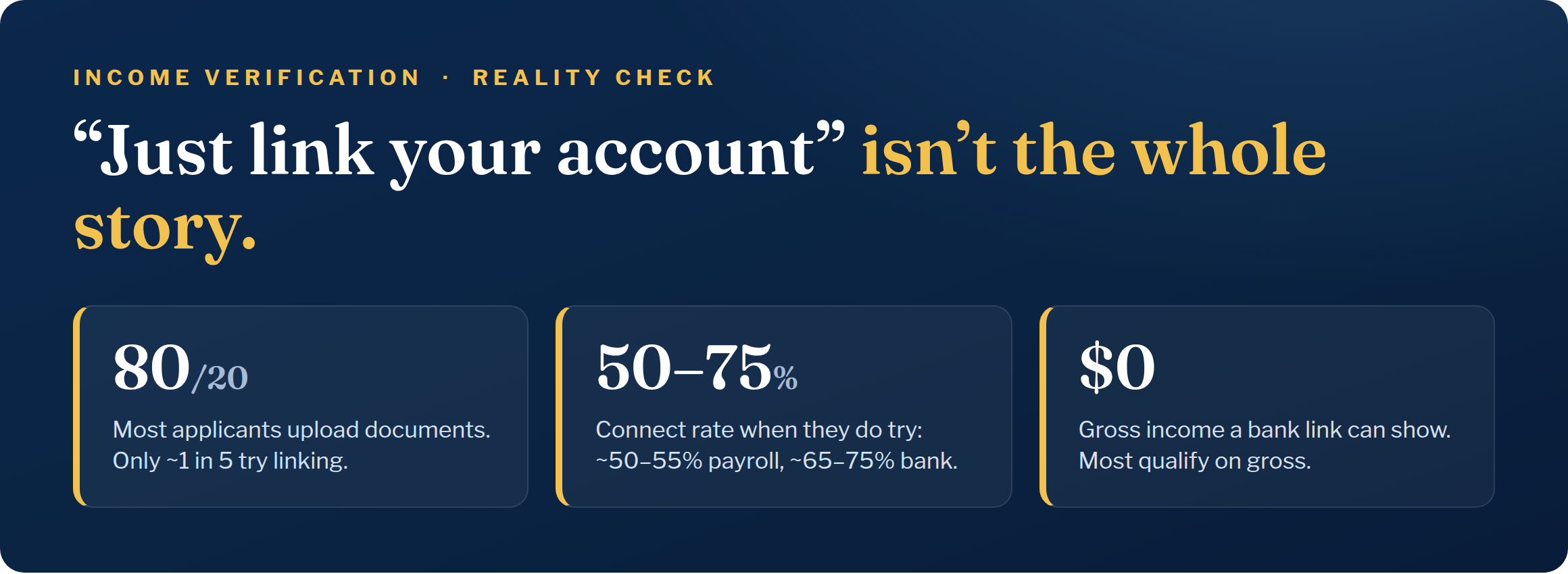
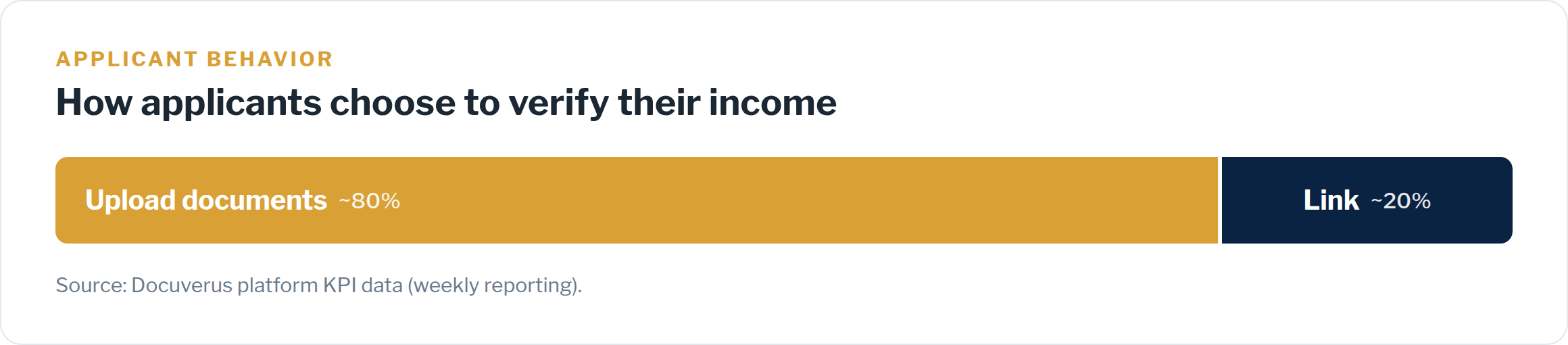
Give applicants a choice and roughly 80% upload documents. Only about 20% attempt to link an account at all. That single number reframes everything. As a result, a method that works for one in five applicants cannot carry your whole verification strategy. It has to be just one option among several.
Trying is not the same as finishing
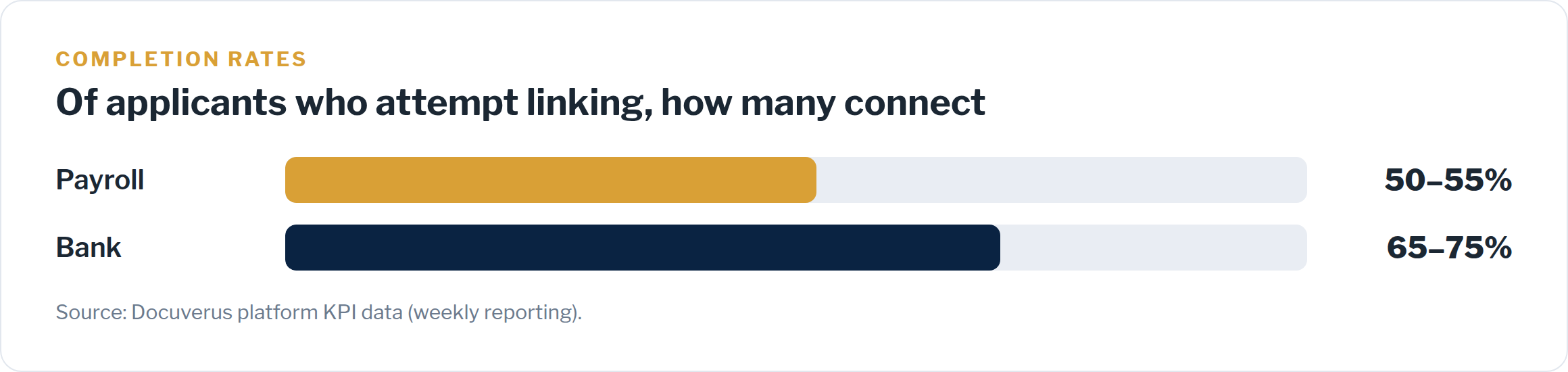
When we look at the applicants who do try, only 50-55% successfully connect a payroll provider. 65-75% successfully connect a bank account. A large share of the people who wanted to link never even finish through with the process.
Why? The reasons are pretty simple.
- They cannot find their employer, payroll provider, or bank in the list.
- They do not remember their password, and they will not stop to reset it mid-application.
- They get stuck on the multi-factor authentication step.
- The connection simply fails.
In fact, none of these are edge cases. This is what happens when you ask a busy person to authenticate an account they log into twice a year.
The applicants you most need to catch will not link
Now ask the harder question. Who does account linking actually verify?
To begin the linking process, an applicant has to connect a real payroll or bank account with their real income sitting inside it. That is exactly what a fraudster does not have and does not want you to see. Someone submitting fabricated pay stubs is not going to hand you a live connection that contradicts them.
So, linking self-selects quietly. It tends to verify your honest applicants, the ones who were never the risk, while the applicants you most need to catch choose the upload path instead. A method that the fraudulent simply decline is not a fraud strategy on its own.
Even a successful link has a blind spot
Say the applicant gets through; you still hit a wall that no better interface can fix.
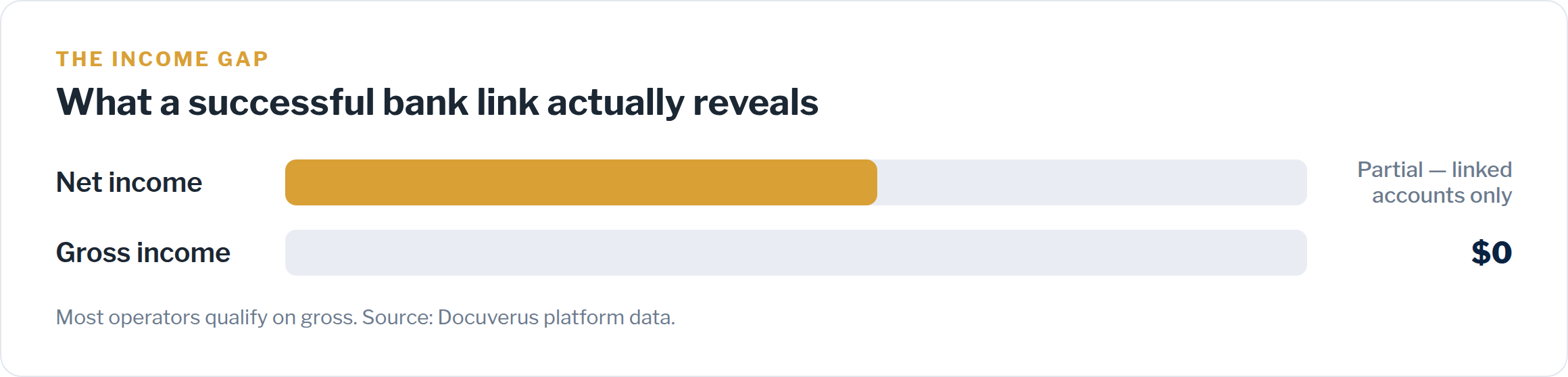
Bank linking shows you net income, what actually landed in the account. And it only shows the accounts the applicant chooses to connect. In addition, plenty of people split their pay across more than one account. Unless they link every account, and they rarely do, you are seeing a partial picture of even their net.
Here is the part that matters most. Bank linking will never show gross income. And most operators qualify on gross, not net. That is not a small gap. It is the number your decision is built on.
“Just use gross pay” does not close the gap
The usual workaround is a gross-up, estimating gross from observed net. In practice, those estimates are unreliable. Effective tax rates swing widely by household, state, filing status, pre-tax deductions, benefits, and garnishments. An estimate built on assumptions is not a substitute for the real figure when you are approving an applicant for their rental.
So, is account linking bad? No!
This is easy to hear as an attack on bank account and payroll linking. It is not. Account linking is a strong, high-confidence method for the applicants who choose it and complete it. The mistake is calling it THE answer to income verification. When a provider frames it that way, they are usually leaving out the completion rates, the friction, and the gross-income limitation. The very facts above.
Meet applicants where they are
The most defensible strategy is not linking or documents. It is both, plus the analysis to trust either one. Let applicants verify the way they will actually finish. Capture gross income where it counts. Apply real fraud detection to every document and data feed you receive.
Account linking keeps one door open. Verifying every applicant, every way they apply, keeps the whole house covered.
Frequently asked questions about account linking and income verification
Is account linking better than uploading documents for income verification?
Not on its own. Account linking is a strong, high-confidence method for the roughly 20% of applicants who choose it and complete it. But most applicants (about 80%) upload documents instead, many link attempts never finish, and even a successful bank link cannot show gross income. The most reliable approach is to support both linking and documents, backed by fraud detection and income analysis.
Why do so many payroll and bank link attempts fail?
Of applicants who attempt to link, only about 50-55% successfully connect a payroll provider and about 65-75% connect a bank. Attempts stall for ordinary reasons: the applicant cannot find their employer, payroll provider, or bank in the list, they do not remember their password and will not reset it mid-application, they get stuck on multi-factor authentication, or the connection simply errors out.
Does bank linking show gross income?
No. Bank linking can, at best, show net income, and only for the accounts an applicant chooses to connect. It will never show gross income. Because most property managers qualify applicants on gross income, this is a significant gap for rental screening.
Is a gross-up estimate from net income accurate?
Usually not accurate enough to base an approval on. A gross-up estimates gross income from observed net, but effective tax rates vary widely by household, state, filing status, pre-tax deductions, benefits, and garnishments. An estimate built on assumptions is not a substitute for the real gross figure.
Do fraudsters use account linking?
Rarely. A fraudster using fabricated income will not connect a real payroll or bank account that contradicts their story. Account linking tends to self-select honest applicants who were never the risk, while the applicants you most need to catch choose the document upload path instead. That is why linking alone is not a complete fraud strategy.
What is the best way to verify a rental applicant’s income?
Meet applicants where they are. Let them verify whichever way they will actually complete, whether that is account linking or uploading documents, capture gross income where it matters, and apply real fraud detection to every document and data feed. Verifying every applicant, every way they apply, protects the portfolio far better than relying on a single method.